

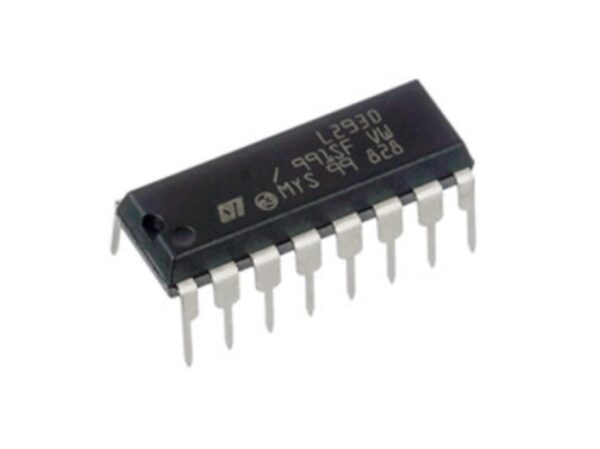
L293D Bipolar Motor Driver Parallel IC 16-PowerDIP
$ 0.27
Description The easiest and inexpensive way to control DC motors is to interface the L293D Motor Driver IC with the Arduino. It can control both the speed and the spinning direction of two DC motors. And as a bonus, it can also control a unipolar stepper motor like the 28BYJ-48 or a bipolar stepper motor like the NEMA 17. The L293D is a dual-channel H-Bridge motor driver capable of driving a pair of DC motors or a single stepper motor. This means it can drive up to two motors individually which makes it ideal for building a two-wheeled robotic platform. The L293D is most often used to drive motors, but can also be used to drive any inductive load such as a relay solenoid or large switching power transistor. It is capable of driving four solenoids, four uni-directional DC motors, two bi-directional DC motors or one stepper motor. The L293D IC has a supply range of 4.5V to 36V and is capable of 1.2A peak output current per channel, so it works very well with most of our motors. The IC also includes built-in kick-back diodes to prevent damage when the motor is de-energized Specifications: L293D Motor Driver IC Pinout The L293D IC has a total of 16 pins that connect it to the outside world. The pinout is as follows: Let’s get acquainted with all the pins one by one. Power Pins The L293D motor driver IC actually has two input power pins – VS and VSS. VS (Vcc2) pin gives power to the internal H-Bridge of the IC to drive the motors. You can connect an input voltage anywhere between 4.5 to 36V to this pin. VSS (Vcc1) is used to drive the internal logic circuitry which should be 5V. GND pins are common ground pins. All 4 GND pins are internally connected and used to dissipate the heat generated under high load conditions Output Pins The L293D motor driver’s output channels for the motor A and B are brought out to pins OUT1,OUT2 and OUT3,OUT4 respectively. You can connect two 5-36V DC motors to these pins. Each channel on the IC can deliver up to 600mA to the DC motor. However, the amount of current supplied to the motor depends on system’s power supply. Direction Control Pins By using the direction control pins, you can control whether the motor rotates forward or backward. These pins actually control the switches of the H-Bridge circuit inside the L293D IC. The IC has two direction control pins for each channel. The IN1 and IN2 pins control the spinning direction of motor A; While IN3 and IN4 control the spinning direction of motor B. The spinning direction of the motor can be controlled by applying logic HIGH (5V) or logic LOW (Ground) to these inputs. The chart below shows how this is done. IN1 IN2 Spinning Direction Low(0) Low(0) Motor OFF High(1) Low(0) Forward Low(0) High(1) Backward High(1) High(1) Motor OFF Speed Control Pins The speed control pins ENA and ENB are used to turn on/off the motors and control its speed. Pulling these pins HIGH will cause the motors to spin, while pulling it LOW will stop them. But, with Pulse Width Modulation (PWM), you can actually control the speed of the motors. Wiring a L293D Motor Driver IC to an Arduino Now that we know everything about the IC, we can start connecting it to our Arduino! Let’s start by connecting the power supply to the motors. In our experiment we are using DC gearbox motors (also known as ‘TT’ motors) commonly found in two-wheel-drive robots. They are rated for 3 to 12V. Therefore, we will connect the external 5V power supply to the VS (Vcc2) pin. Next, we need to supply 5V to the logic circuitry of the L293D. Connect the VSS (Vcc1) pin to the 5V output on the Arduino. And make sure your circuit and Arduino share a common ground. Now connect the L293D IC’s Input and Enable pins (ENA, IN1, IN2, IN3, IN4 and ENB) to the six Arduino digital output pins (9, 8, 7, 5, 4 and 3). Note that Arduino output pins 9 and 3 are both PWM-enabled. Finally, connect one motor to OUT1 and OUT2 and the other motor to OUT3 and OUT4. You can interchange the connections of your motor. There is technically no right or wrong way. When you are done you should have something that looks similar to the illustration shown below. Packing List: 1 x L293D Bipolar Motor Driver Parallel IC 16-PowerDIP